







































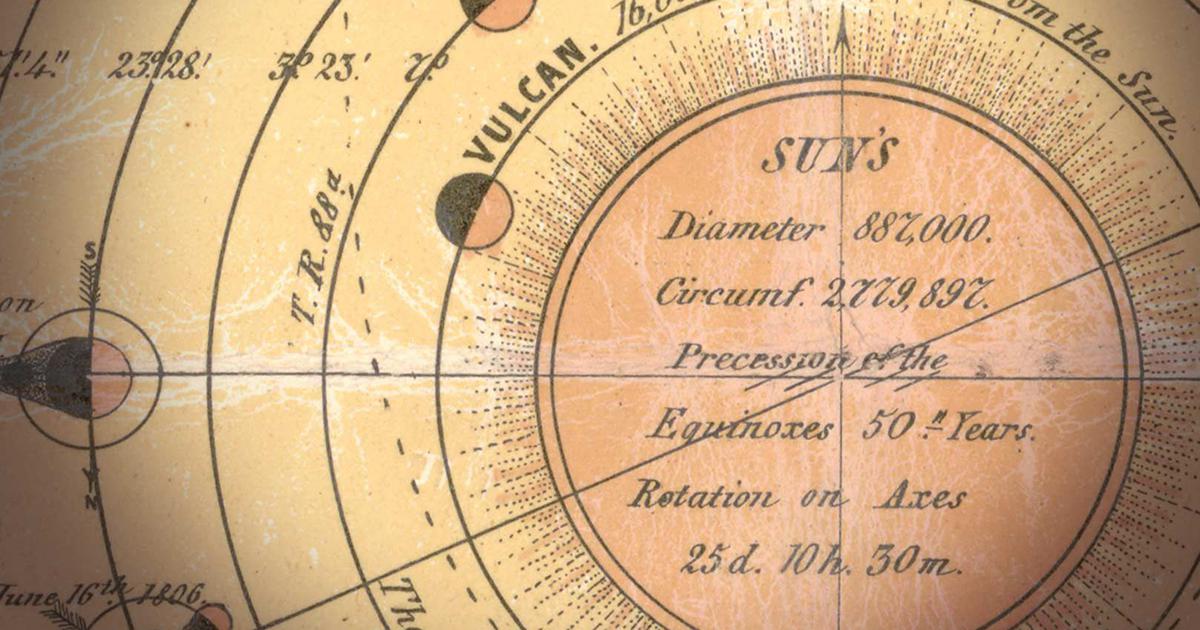
How Vulcan, a hypothetical planet, helped prove Einstein’s theory that gravity is curved spacetime
Join our WhatsApp Community to receive travel deals, free stays, and special offers!
- Join Now -
Join our WhatsApp Community to receive travel deals, free stays, and special offers!
- Join Now -

In the 1850s, Urbain Le Verrier, fresh from his triumph in predicting the existence of Neptune based on the wobbles in Uranus’s orbit, turned his attention to the closest known planet to the Sun, Mercury. He noted that the orientation of Mercury’s orbit, when it was closest to the Sun, was advancing more than expected by a tiny angle each century. Though seemingly small, this shift could not be accounted for by what was understood of Newtonian mechanics and the influence of other planetary bodies on Mercury.
Le Verrier hypothesised that perhaps Mercury, too, was receiving a tug from an undiscovered planet that was closer to the Sun and so luminously bathed in sunlight that it remained hidden in its glare. This hypothetical planet, imagined to be even closer to the Sun than Mercury, he named Vulcan, after the Roman god of fire.
In the following decades, numerous sightings of this new planet were reported by both amateur and professional astronomers. They sought to catch a glimpse of Vulcan as it transited across the Sun’s disc or during a solar eclipse, when objects near the Sun might be more easily observed. Still, the intense glare of the Sun made such observations extremely challenging; it...
Read more
What's Your Reaction?
 Like
0
Like
0
 Dislike
0
Dislike
0
 Love
0
Love
0
 Funny
0
Funny
0
 Angry
0
Angry
0
 Sad
0
Sad
0
 Wow
0
Wow
0










![Cruise 2 Ton 3 Star Inverter Split AC – Now Only ₹38,490 [MRP: ₹64,900] on Amazon!](https://savefree.in/uploads/images/202607/image_870x580_6a6870eb6880c.webp?#)