







































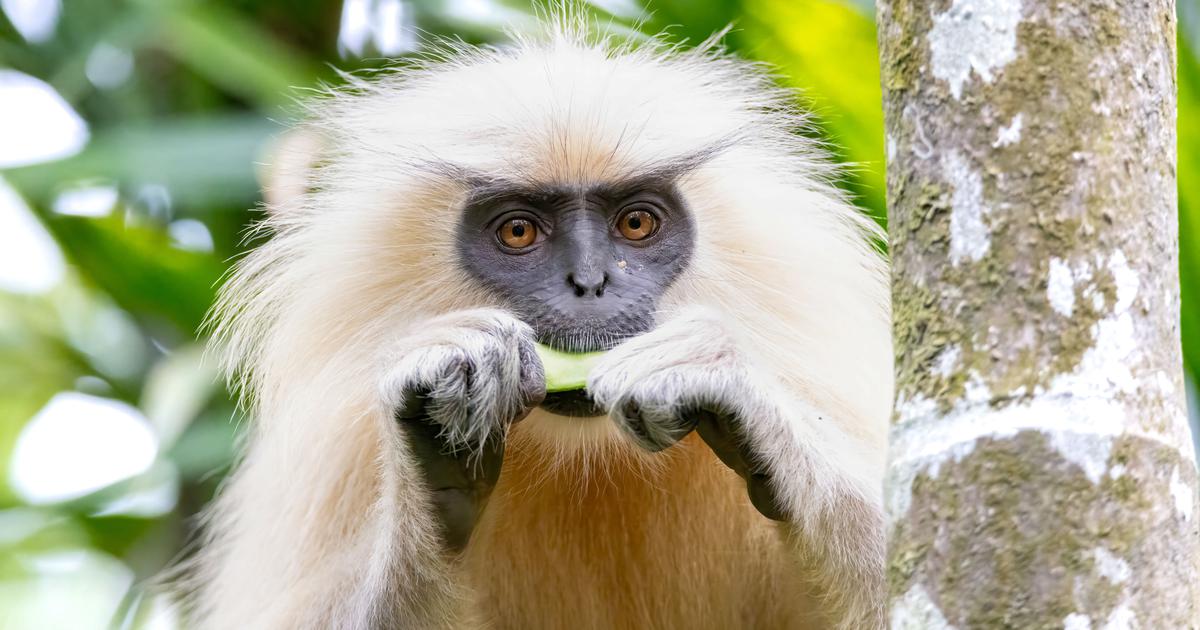
Long considered sacred, the golden langur, found in western Assam, is now an endangered animal
Join our WhatsApp Community to receive travel deals, free stays, and special offers!
- Join Now -
Join our WhatsApp Community to receive travel deals, free stays, and special offers!
- Join Now -

Being confined to the sal-dominated (Shorea robusta) tropical moist deciduous and semi-evergreen forests in India, and the sub-tropical and temperate broad-leaved forests in the India – Bhutan landscape, the golden langur stands out as the most restricted colobine (leaf-eating primate) species in India. Although described by earlier naturalists such as RB Pemberton and CM Inglis and co-workers during the 19th century as “cream colored monkey” and “Sankosh cream langurs”, the credit for suggesting that it could be a new species goes to EP Gee, a British tea planter and conservationist living in Assam. It was formally described in 1956 by H Khajuria of the Zoological Survey of India and named Presbytis geei in honour of Gee.
The golden langur is a medium-sized primate. Males weigh 10-12 kg and females 9.5-10 kg. They are less sexually dimorphic than other colobines such as grey langurs (Semnopithecus spp). Based on phylogeny and biogeography, T Wangchuk, a Bhutanese biologist, opined that Trachypithecus geei and T pileatus (capped langurs) branched off from an ancestral Trachypithecus from South Asia. In addition, the Sankosh River and Pele La mountain system in central Bhutan isolated a population of capped langurs during a warming period in central Bhutan, and this population later specialised into the morphologically distinct golden langur.
In India,...
Read more
What's Your Reaction?
 Like
0
Like
0
 Dislike
0
Dislike
0
 Love
0
Love
0
 Funny
0
Funny
0
 Angry
0
Angry
0
 Sad
0
Sad
0
 Wow
0
Wow
0









![Cruise 2 Ton 3 Star Inverter Split AC – Now Only ₹38,490 [MRP: ₹64,900] on Amazon!](https://savefree.in/uploads/images/202607/image_870x580_6a6870eb6880c.webp?#)