




































How Jain scrolls blurred the line between art, publicity and city portraits
Join our WhatsApp Community to receive travel deals, free stays, and special offers!
- Join Now -
Join our WhatsApp Community to receive travel deals, free stays, and special offers!
- Join Now -

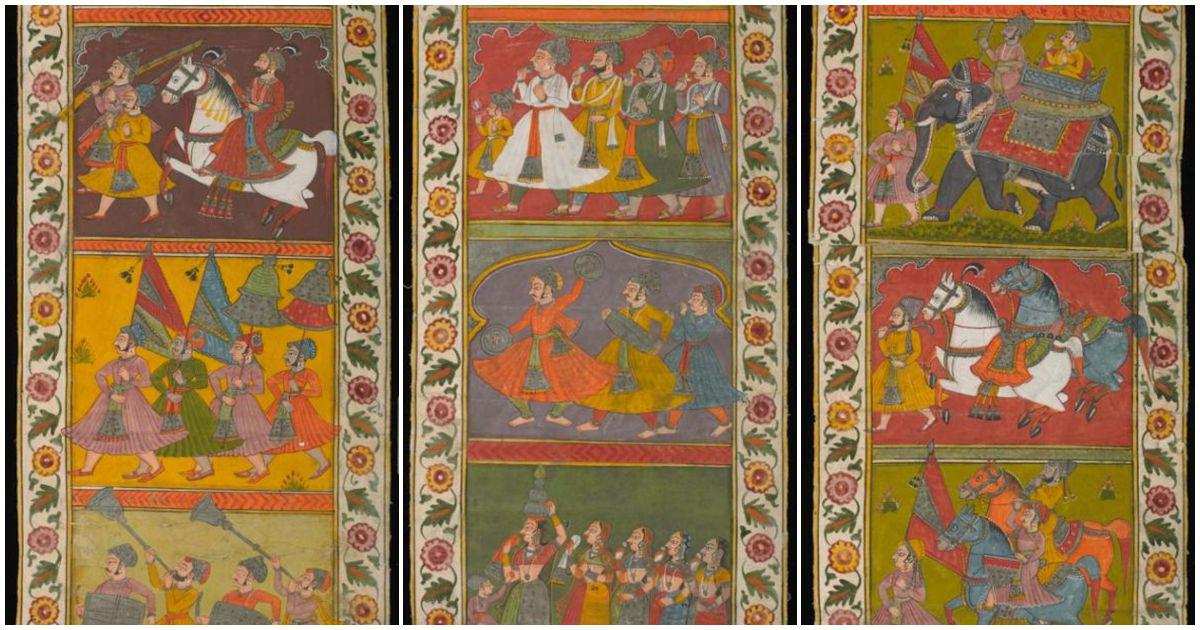
Badshah Jahangir appears in profile at his jharoka. Soon, three men come into view – two noblemen holding rolled-up papers, one atop an elephant and a third in white robes. The court scene gives way to the bustle of the city outside, to a public space teeming with musicians, monks, merchants and officials. Finally, two white-robed individuals read from a long piece of paper to a similarly attired distinguished figure seated in a pavilion, surrounded by disciples, performers and women making an auspicious swastika design with rice.
These vignettes, composed in Agra in 1610 by artist Ustad Salivahan, illustrate a letter recording how a contingent of Jain priests convinced Mughal emperor Jahangir to issue a farman prohibiting animal slaughter during the eight Jain holy days of Paryushan and then communicating this news to subjects and laity.
Roughly three metres long and as wide as an A3 sheet, the scroll is currently accessible not in its original, physically fragile form, unfolded bit by bit. Instead, it appears byte by byte as a high-resolution scan on a monitor at the Lalbhai Dalpatbhai Institute of Indology in Ahmedabad, one of the world’s foremost repositories of Jain art.
Beyond its intriguing narrative, the Agra scroll is notable for its form....
Read more
What's Your Reaction?
 Like
0
Like
0
 Dislike
0
Dislike
0
 Love
0
Love
0
 Funny
0
Funny
0
 Angry
0
Angry
0
 Sad
0
Sad
0
 Wow
0
Wow
0